November 2026 · 28 minute read
The Uber Song
How quiet cars found their voices
Prelude: The Sound of Silence
We don’t own a car. Every Wednesday my son Laurent, Lolo, has a piano lesson, and we take an Uber to it. The car rolls up to the curb, and as I greet the driver I strap a car seat into the back.
Lolo is four and, like any young kid, has started noticing cars: “Firetruck!” “Police!” Anything that makes lots of noise. So when he began saying “Dad, Uber!” and was usually right, I got curious and asked him how he knew.
“It makes that sound,” he said.
That sound! I’d been hearing it all over Toronto, more and more each year. I play piano, and to me it was a song: often a full, beautiful chord, rich in harmonics.
One car's warning sound · Volkswagen ID.3
The Volkswagen ID.3's warning sound, from a research recording, not one of our pickups. Low rumble filtered out.
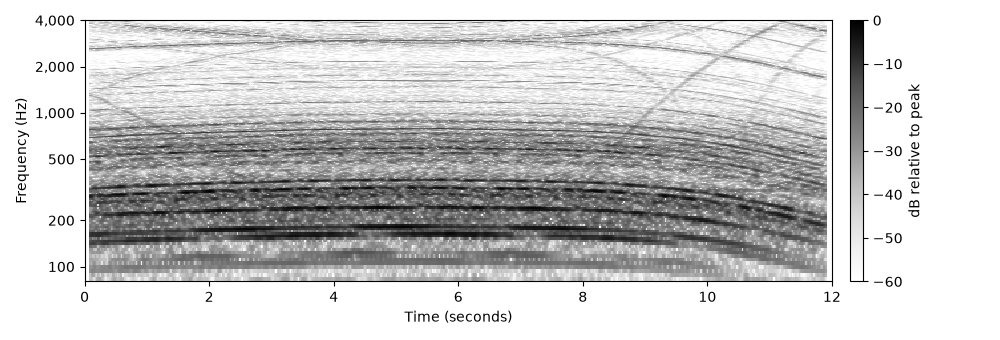
It reminded me of the famous last chord of the Beatles’ “A Day in the Life”:
The last chord of "A Day in the Life" · The Beatles, 1967
Listen to the sustained final chord, and compare its layered hum with the cars' warning sounds.
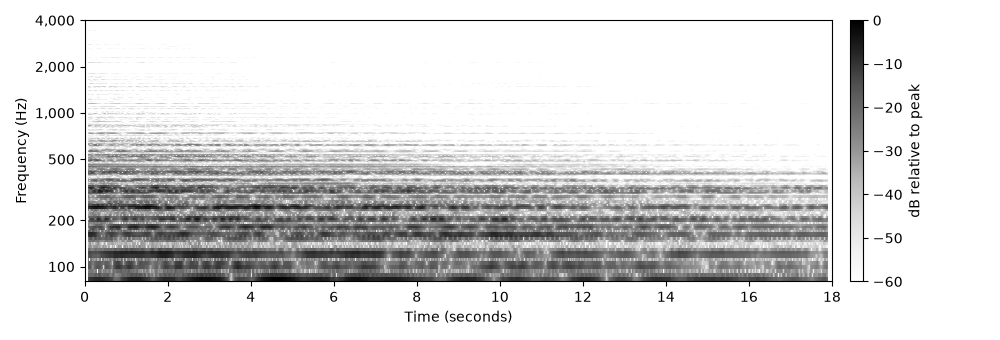
The idealist in me took it for the sound of the electric motor itself. It seemed fitting that a cleaner car should sound so much more beautiful than a gas one.
It was a lovely idea, and it was wrong. On their own, cars with electric motors are nearly silent at slow speeds. I should have remembered: once or twice in a parking garage I’d turned around to find an electric car rolling along behind me, politely waiting for me to notice. The song comes from a loudspeaker facing outward, played on purpose by a small computer that reads the car’s speed and gear, so that people on foot know a car is coming.1,2
We started calling it the Uber song. But why would anyone design a car to sing? And why did Lolo hear it and think Uber, and not just any car?
I never guessed that chasing those questions would turn up so much history and lore. It starts with sleigh bells:
Jingle Bells
Pre-motor cars: sleigh bells and red flags, then quiet cabs
The idea of a warning sound for pedestrians is far older than the car itself. I was surprised to learn that Ontario’s Highway Traffic Act still has a section headed “Sleigh bells”: anyone travelling on a highway with a sleigh drawn by a horse or other animal “shall have at least two bells attached to the harness or to the sleigh or sled in such a manner as to give ample warning sound.”
The fine, to this day, is “not more than $5.”3 The rule is older than Canada. Upper Canada passed it in 1812, requiring “two or more bells to the harness.”4
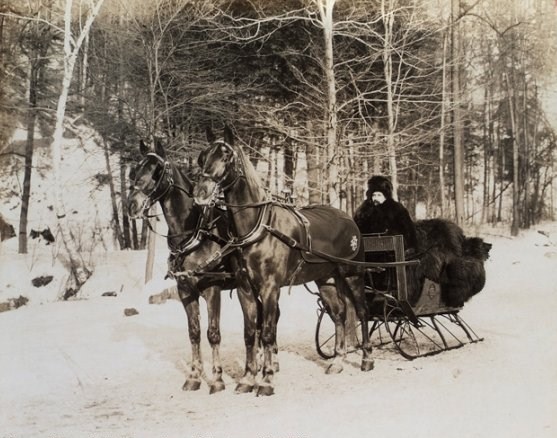

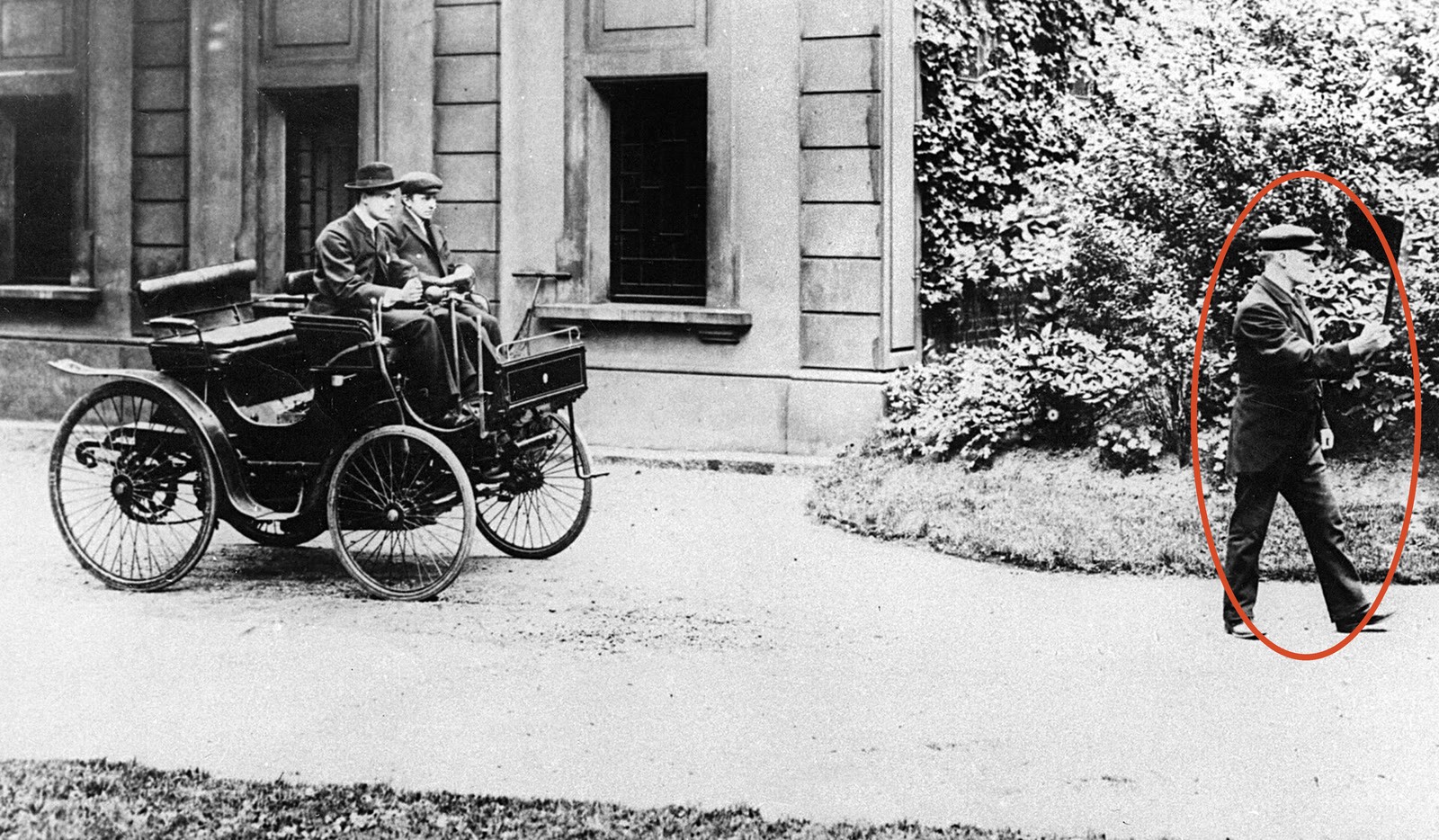

Britain went further. The first machines on its roads were steam engines called road locomotives. An 1865 law made a man walk at least 60 yards ahead of each one, carrying a red flag.5 The motor car got its own voice in 1896, when the law required a bell or other instrument, and a 1904 order made drivers sound it “whenever necessary” to give “audible and sufficient warning of the approach or position of the motor-car.”6,7
Within a decade of that first bell, someone complained about quiet cars. In 1905 a member of Parliament asked whether anything required “electric motor-cars” to give that warning. A regulation did, he was told. “Is the right hon. Gentleman aware,” he replied, “that that regulation is habitually disregarded by nearly all electrical broughams in London?” Broughams were electric carriages, many of them cabs.7,8
Do You Hear What I Hear?
Enter the hybrid: blind pedestrians and new laws
After almost a century of the combustion engine, silence finally returned with the hybrid, and blind pedestrians were the first to notice. By 2007, news stories were warning that nearly silent hybrids endangered them.9
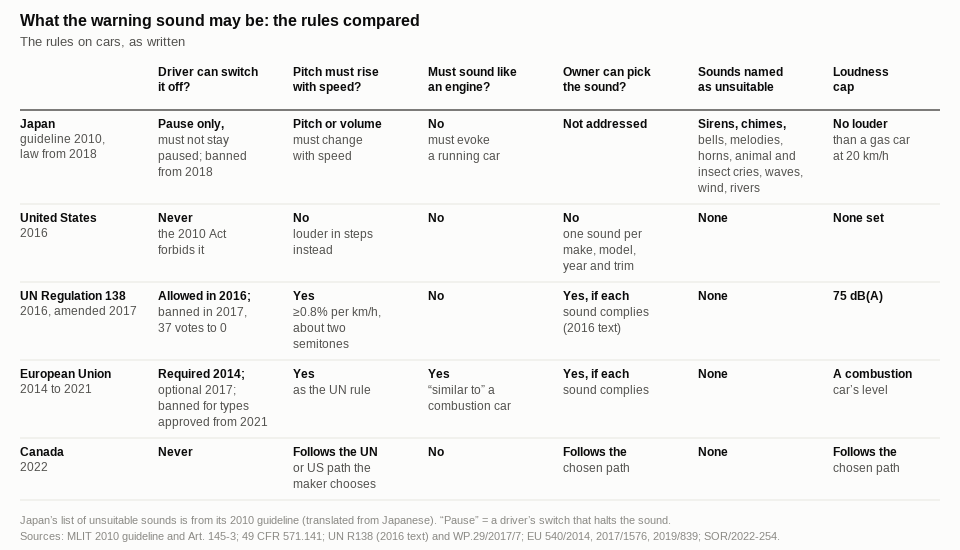
Japan acted first, with a guideline in January 2010.10 The United States followed with a law in January 2011, backed by the National Federation of the Blind.11,12 In 2016 countries agreed on a shared rule through the United Nations in Geneva,13 and in 2017 they voted, 37 to none, that drivers may not switch the sound off.14 Japan, Europe and the United States phased it in on new cars between 2018 and 2021,15,16,17 and Canada’s rule took effect on 21 December 2022.18,19
When Doves Cry
No animal sounds!
So what should it sound like? Japan’s 2010 guideline was the first to say. It should be “a continuous sound that evokes the running state of the vehicle.”10 Then it lists what the sound should not be, or even resemble (translated from Japanese):
-
Not sirens, chimes, bells or melodies.
-
Not the sound of a horn.
-
Not the cries of animals or insects.
-
Not the sounds of nature, such as waves, wind and flowing rivers.
-
Not anything else common sense wouldn’t expect from a vehicle.
The bell, the oldest warning in this story, was out, and so were animal cries.
The committee behind the guideline worried about the neighbours, too. A sound that never stops, its report said, will annoy people who live nearby, and drivers might speed up until it switches off, or pull the device out (translated from Japanese).20
Different Drum
Europe chose an engine-like sound. Its rule says the sound “shall be similar to the sound of a vehicle of the same category equipped with an internal combustion engine.”21
The UN rule doesn’t require an engine sound. It caps loudness and requires at least two bands of pitch (one fairly low) and at least one tone that rises as the car speeds up.22
The American rule makes the warning louder in steps but doesn’t require its pitch to rise, and it adds that every car of the same make, model, year, body type and trim “shall be designed to have the same pedestrian alert sound” at the same speed.2 Carmakers asked to let drivers choose. “One size does not fit all,” their petition said.23 In 2022 the safety agency said no, for “a lack of supporting data.”24
In December 2020 a software update gave Teslas a Boombox mode that played goat bleats, applause or fart sounds through the car’s outside speaker.25 In February 2022 Tesla recalled 578,607 cars to switch it off while driving, because, according to NHTSA, it “may obscure the Pedestrian Warning System (PWS) sounds.”26
Good Vibrations
Enter sound designers
Car sound designers took the brief more seriously. “We decided that if we’re going to do this, if we have to make sound, then we’re going to make it beautiful and futuristic,” said Toshiyuki Tabata, Nissan’s noise and vibration engineer, in 2009.27 Nissan tried about a hundred options with blind advocates, a Hollywood sound studio and psychologists who study hearing.28
Jaguar shelved a sound inspired by science-fiction spacecraft because pedestrians kept looking up at the sky.29
Designers usually build the sound as a short loop that plays faster as the car speeds up, then layer more on top so it doesn’t sound like a record spun too fast. For Cadillac, one designer told Vox, that meant an ancient Australian instrument and “two entire orchestras.”30
Ebony, Ivory and a Model Y
Music theory of car songs
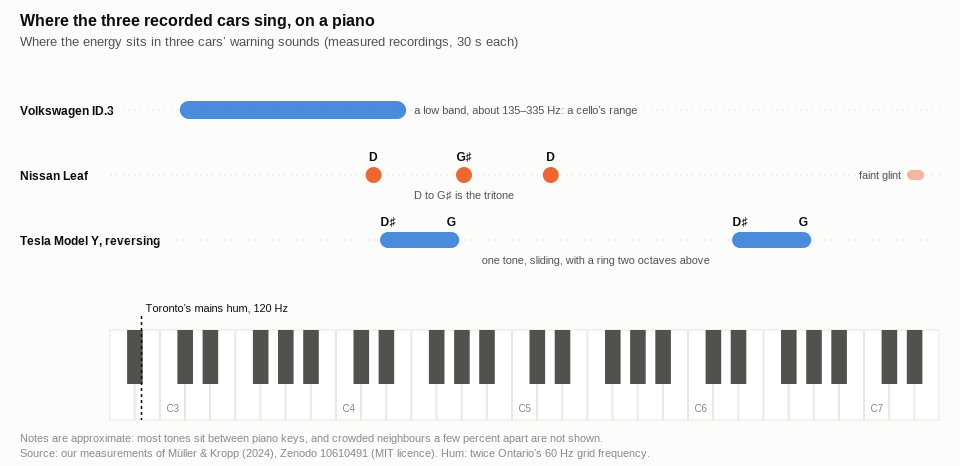
Two acoustics researchers, Müller and Kropp, published recordings of the sound from a Volkswagen ID.3, a Nissan Leaf and a Tesla Model Y. Listen first for the low body of each sound, then for the higher tones on top.31
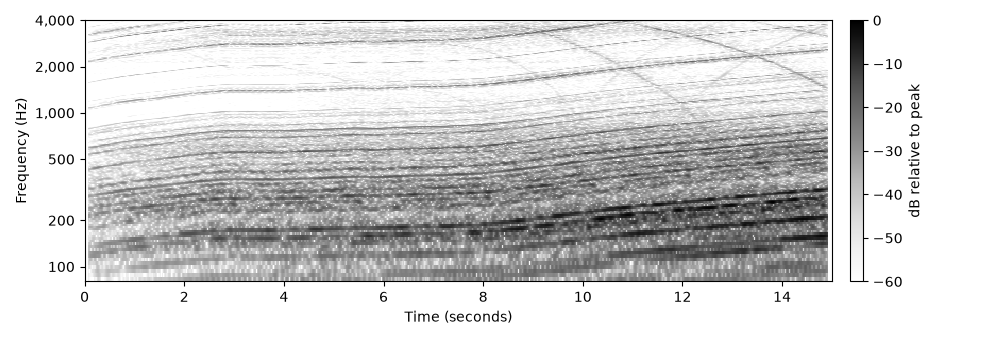
Volkswagen ID.3 · 2021
The car you heard at the top. A lower hum, with most of the energy in the cello’s range.
Nissan Leaf · 2018
A middle register, with a faint band of higher sound.
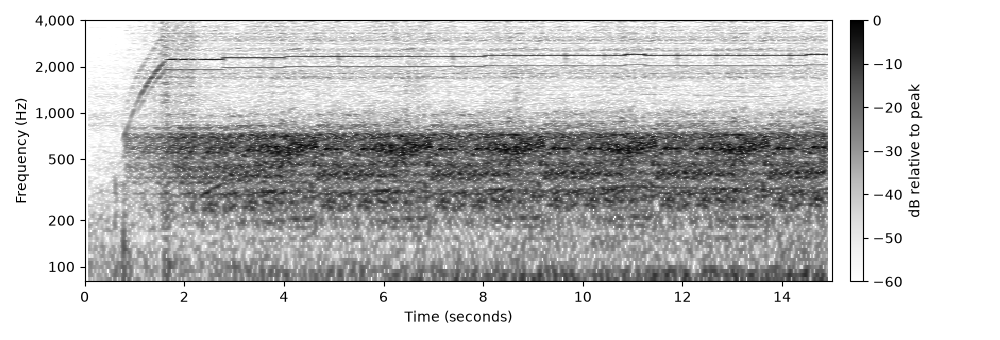
Tesla Model Y · 2021 · reversing
One clear tone with a fainter ring two octaves above, sliding up and down as the car backs up. Its forward sound is mostly hiss.
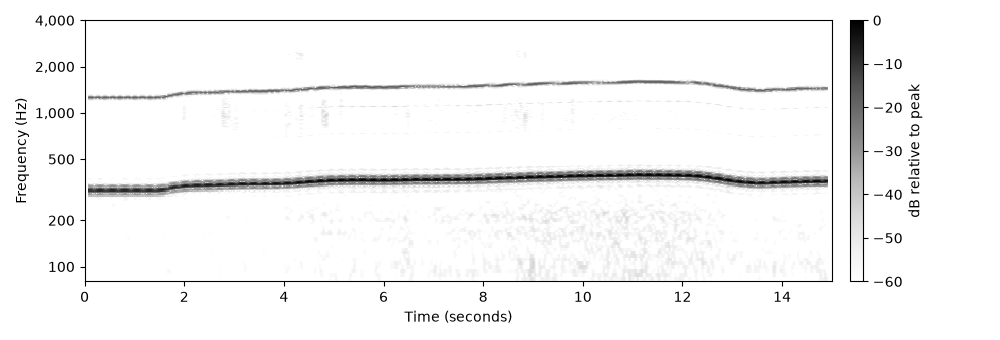
The Volkswagen hums low, in a cello’s range. The Leaf sits in the middle, with a faint glint high above. The Tesla is the odd one out. Going forward, its sound is mostly hiss, shaped into two bright bands, so the recording here is the Tesla backing up. In reverse it plays one clear tone, sliding between about a D-sharp and a G, with a fainter ring exactly two octaves above.32 A Model 3 owner on YouTube describes the same split: a rumble going forward, and in reverse “this UFO kind of like wobbly type sound.”33
The other two are dense clusters of tones, with a few pitches standing out. The Leaf’s tones hover around a D, the G-sharp above it, and another D an octave up. On the keyboard above, D to G-sharp is six steps, counting every key, black or white. That’s the tritone, an unsettled interval once nicknamed “the devil in music.”34 The Volkswagen stacks many tones, low and close together, gliding upward in parallel. Those stacked tones are the chord I hear, with its overtones.32
Listen to the Music
Some cars are more musical than others. The rules say how loud the sound must be and how its pitch must move, but nothing about whether it’s beautiful. That part is left to the designers, and some of them reach for music.
One car in England leans all the way into the chord. Someone making field recordings around Plymouth caught its warning sound and shared it on Freesound, an open sound library, without naming the car. Its three lowest tones sit in the ratio 4 to 5 to 6. That’s a major chord, pitched between F and F-sharp, with its overtones stacked above.35
An unnamed electric car · Plymouth, England
A field recording shared as an electric car’s pedestrian warning sound; the car isn’t named. Three low tones form a major chord, with their overtones above.
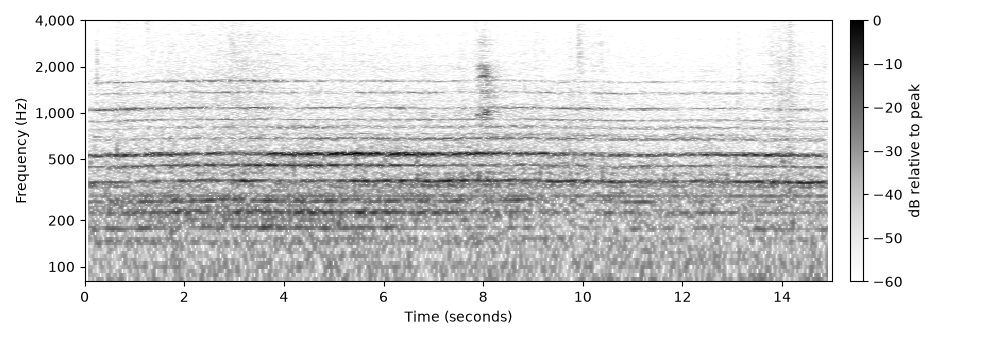
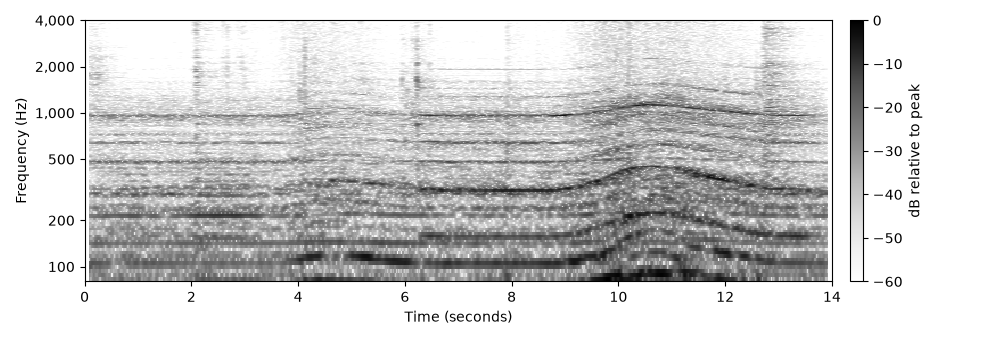
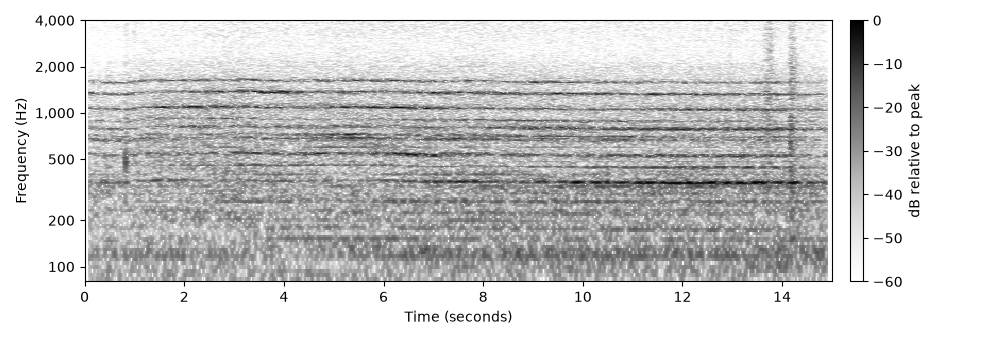
It isn’t the only one. The owner of a 2022 Hyundai Tucson Hybrid posted the sound it makes at low speed, on battery power, and called it “angelic.”36 A Porsche Taycan, filmed outside a dealer in Norway, layers low tones that bend and climb as it moves.37 To my ear, the 2019 Audi e-tron comes closest. It sounds a lot like the last chord of “A Day in the Life”: a dense stack of tones from deep bass to well above middle C.38
Audi e-tron · 2019
The low-speed warning sound, recorded outside the car. A dense stack of steady tones that bend together as the speed changes.
Hyundai Tucson Hybrid · 2022
An owner’s recording of the car at low speed, on battery power. Several high, steady tones.
Porsche Taycan · filmed 2020
Filmed outside a Porsche dealer in Stavanger, Norway. Low tones that bend and climb as the car moves.
Slip Slidin’ Away
Doppler’s effects on songs
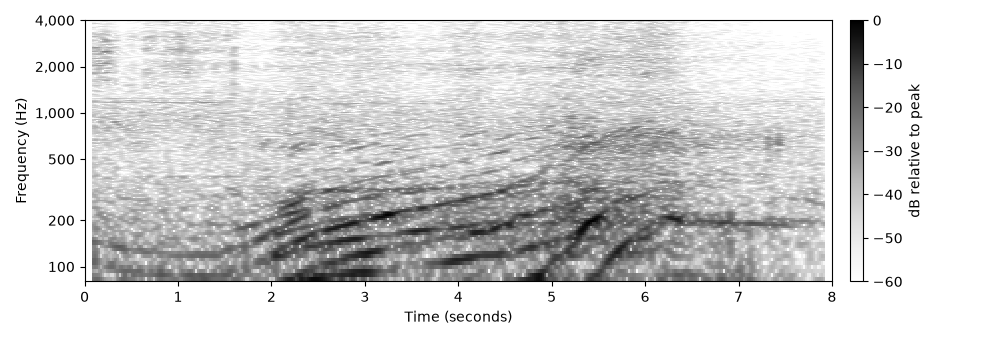
Under the UN rule, at least one tone must rise in pitch as the car speeds up from walking pace to 20 km/h, by about two steps in all, roughly C to D.22,39 That’s a minimum; designers can make it climb further. A car pulling away from the curb sings a small upward slide.
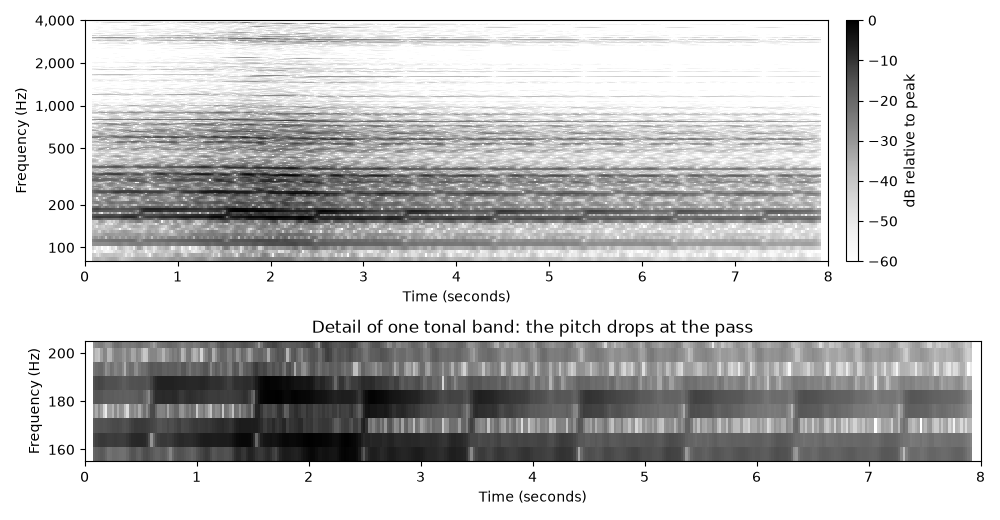
Then the street bends it again. As a car passes you its pitch drops, higher coming toward you and lower going away, from the same Doppler effect that makes a passing siren fall. At 20 km/h the drop is just over half a step.39
Volkswagen ID.3 · simulated pass-by at 20 km/h
The measured warning sound alone, simulated passing 3 metres away at 20 km/h. Listen for the pitch drop as it passes; there is no tire noise.
Electric Avenue
The city has its own songs
So the idealist in me wasn’t crazy. Electricity does sing on its own. Long before any rule required electric cars to sing, wires, transformers and motors were making music nobody designed.
Cities already live with electric sounds, starting with the grid. Ontario’s power runs at 60 cycles a second, and transformers commonly hum at twice that, a low note about halfway between a B-flat and a B.40 In Europe, on 50-cycle power, the hum sits near a G.39
Mystery Train
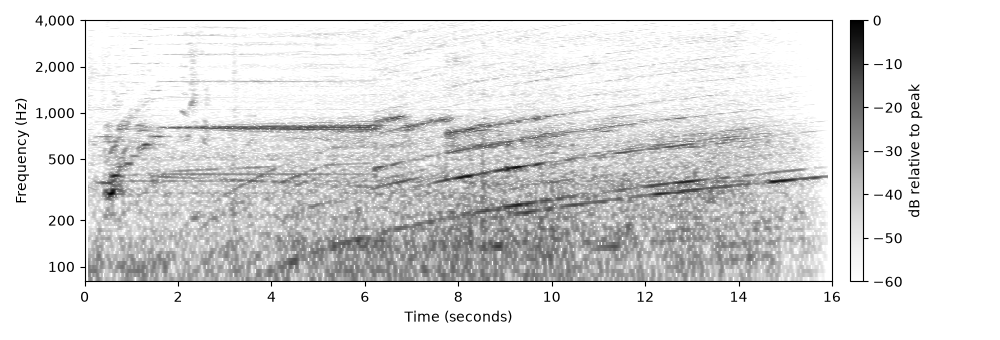
Japan had a singing train. In 1998 Keikyu, a Tokyo-area railway, brought in trains whose motors were driven by switching the current on and off many times a second. The switching made the motors vibrate, and the engineers tuned that vibration into a rising scale. No speaker played it; it was the motors themselves, singing as each train pulled away. Fans called them the singing trains. From 2008 the equipment was replaced, and the last of those trains fell silent in July 2021.41,42,43
Keikyu N1000 · the singing train
The motors themselves, not a chime. Listen for the rising steps as the train pulls away.
Do-Re-Mi
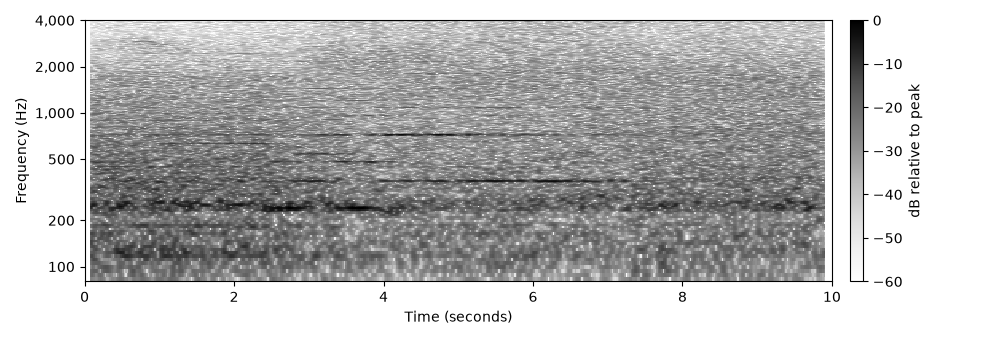
Since 1976, Montreal’s older metro cars have pulled out with three notes riders call the “dou-dou-dou,” a by-product of the electronics that pulse power to their motors. In 2010 the transit agency made those notes its door-closing warning, and later the sound of the whole system.44,45
Montreal metro · the dou-dou-dou
The motors, not the door chime. Listen for the three notes as the train pulls out.
Signal to Noise
A study of soundscapes
The Canadian composer R. Murray Schafer, who gave the study of soundscapes many of its words, sorted a place’s sounds into signals and keynotes. Signals are “listened to consciously,” among them those “which must be listened to because they constitute acoustic warning devices: bells, whistles, horns and sirens.” A keynote, he wrote, “is a musical term; it is the note that identifies the key.” Keynote sounds “are overheard but cannot be overlooked,” and for a landscape they are “water, wind, forests, plains, birds, insects and animals.”46
Set Japan’s list beside Schafer’s keynotes and the overlap is plain: water, wind, insects, animals. Japan advised against any warning that could be mistaken for the background. The Uber song was built to be a signal. But keynotes, Schafer wrote, “become listening habits in spite of themselves.”46
Drive My Car
So why Uber?
Back to my original question: why would a four-year-old hear this sound and say Uber? My first guess was that so many Uber drivers in Toronto had gone electric. That was half right. Around Toronto, hybrids and plug-in cars went from about one new car in seventeen in 2020 to more than one in four in 2026. But most of them are ordinary hybrids, the kind you never plug in.47 Newer ones play the Uber song too when they creep along on the battery.18
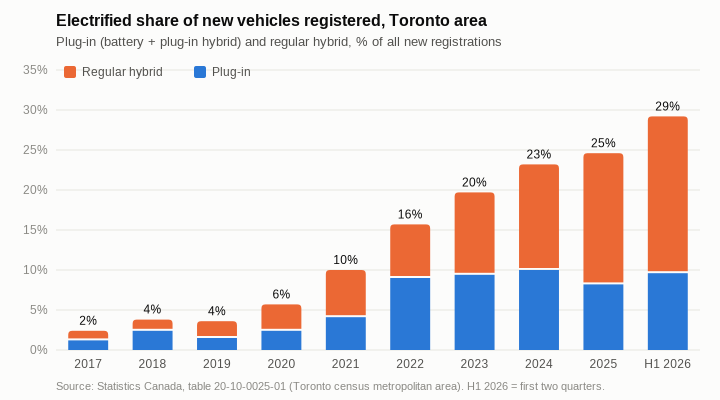
The stories I’d heard about free charging and cheap Teslas turned out to be more complicated, and a trade war moved prices both ways.48 None of it told me what Toronto’s Ubers actually are. I couldn’t find a count.
The simplest answer, and my best guess, is the curb. The rules only require the sound at low speed, up to about 20 or 30 km/h depending on which country’s rule the car follows; above that, tires and wind are loud enough.22,2,49 Most of the traffic a child hears is passing at speed, above that range. An Uber is the car that comes slowly, right to you, and stops beside you while you wait with a car seat. That is the moment the sound was designed for, and Lolo has been standing there for it, again and again.
Coda: A Day in the Life
“A Day in the Life” almost ended on a hum. The Beatles tried one first and found it wasn’t dramatic enough. So on 22 February 1967 they struck a single E major chord on three pianos at once. As it faded, the engineer kept raising the volume until, George Martin said, “you could hear the air-conditioning.”50
As for the Uber song, I know better now. When an Uber pulls up to take us to Lolo’s piano lesson on Wednesdays, the sound he hears is really sleigh bells, blind pedestrians asking to be heard, a vote in Geneva, and a trade war.
But I still hear a song. It means more to me that way, and I hope to pass my love of music on to him.
Sources
Numbers in the text link to these sources, in the order they are first cited. Quotations from Japanese sources are translated into English. The charts are ours, drawn from the same sources.
Sources
-
Automotive Fleet, “Lotus ‘Safe & Sound’ System Makes Quiet Vehicles Audible”, 8 Aug 2008. An early warning sound played from a speaker in the car’s nose. ↩
-
United States, 49 CFR 571.141, Federal Motor Vehicle Safety Standard No. 141, Minimum Sound Requirements for Hybrid and Electric Vehicles (eCFR, current text). ↩ ↩2 ↩3
-
Ontario, Highway Traffic Act, R.S.O. 1990, c. H.8, s. 77, “Sleigh bells” (e-Laws, current consolidation). ↩
-
Upper Canada, An Act to prevent Damage to Travellers on the Highways in this Province, 52 Geo. III c. 4, s. III (1812) (Bills and Acts of the Legislative Assemblies, University of New Brunswick); made permanent in 1819 (59 Geo. III c. 17). ↩
-
The Irish Times, “PastImperfect”, 25 Jun 2003, on the Locomotive Act 1865. ↩
-
Hansard, House of Commons, “Motor Horns (London)”, 15 May 1911, vol. 25 c. 1625, on the Locomotives on Highways Act 1896, s. 3, and the 1904 Order. ↩
-
Hansard, House of Commons, “Electric Motor Broughams”, 25 May 1905, vol. 146 c. 1395. ↩ ↩2
-
Toronto, meanwhile, was writing the opposite kind of law. Its by-law of 3 November 1884, “to prevent certain noises calculated to disturb the inhabitants,” restricted steam whistles at the wharves, but made room for signals the law required and those “absolutely necessary as a signal of danger.” It still is. In May 2026, city council asked Ontario, again, for the power to run noise cameras against loud vehicles, and told staff to study how other cities do it. So Toronto is trying to quiet its loudest cars while federal law requires its quietest ones to make a sound. (Sources: Bob Georgiou, Scenes From Toronto, 2025; Toronto City Council, Cheng and Saxe motion, May 2026; Ted Raymond, CP24, May 2026; Transport Canada, SOR/2022-254.) ↩
-
NPR, “Nearly Silent Hybrid Cars May Endanger the Blind”, 22 Feb 2007. ↩
-
Japan, Ministry of Land, Infrastructure, Transport and Tourism (MLIT), ハイブリッド車等の静音性に関する対策のガイドライン (Guideline on measures for the quietness of hybrid vehicles and others), Jan 2010 (translated from Japanese). ↩ ↩2
-
United States, Pedestrian Safety Enhancement Act of 2010, Pub. L. 111-373, signed 4 Jan 2011. ↩
-
Congressional Record, House, 15 Dec 2010, H8411, debate on the Pedestrian Safety Enhancement Act. ↩
-
United Nations Treaty Collection, UN Regulation No. 138, Quiet Road Transport Vehicles, XI-B-16-138, Geneva, 29 Mar 2016. ↩
-
UNECE World Forum for Harmonization of Vehicle Regulations (WP.29), 171st session, March 2017, vote on ECE/TRANS/WP.29/2017/7: 37 for, none against (via GlobalAutoRegs). ↩
-
MLIT, 「ハイブリッド自動車等の車両接近通報装置」及び「前照灯の自動点灯機能」を義務付けます (Approaching vehicle audible systems and automatic headlamps made mandatory), press release, 7 Oct 2016 (Japanese): new models from 8 Mar 2018. ↩
-
European Union, Regulation (EU) No 540/2014 on the sound level of motor vehicles, Art. 8 and Annex VIII. ↩
-
NHTSA, “Minimum Sound Requirements for Hybrid and Electric Vehicles”, interim final rule, 85 FR 54273, Federal Register, 1 Sep 2020: the phase-in dates. ↩
-
Transport Canada, Regulations Amending the Motor Vehicle Safety Regulations (Minimum Sound Requirements for Hybrid and Electric Vehicles), SOR/2022-254, and its Regulatory Impact Analysis Statement, Canada Gazette, Part II, 21 Dec 2022. ↩ ↩2
-
I also wondered whether people with older cars had to take them back to the dealer. Nobody did. Canada’s rule needed no transition, because Transport Canada found that new hybrid and electric cars already complied. The sound got here with the cars, years before Canada wrote it down. (Sources: Transport Canada, SOR/2022-254.) ↩
-
MLIT, committee on the quietness of hybrid vehicles, ハイブリッド車等の静音性に関する対策について(報告) (Report on measures for the quietness of hybrid vehicles and others), 29 Jan 2010 (translated from Japanese). ↩
-
European Union, Commission Delegated Regulation (EU) 2017/1576, amending Regulation 540/2014 on acoustic vehicle alerting systems, 26 Jun 2017. ↩
-
UN Regulation No. 138, Quiet Road Transport Vehicles, as published in the Official Journal of the European Union, L 9, 13 Jan 2017. ↩ ↩2 ↩3
-
NHTSA, “Federal Motor Vehicle Safety Standard No. 141, Minimum Sound Requirements for Hybrid and Electric Vehicles”, proposed rule, 84 FR 48866, Federal Register, 17 Sep 2019, quoting the carmakers’ 2017 petition. ↩
-
NHTSA, “Minimum Sound Requirements for Hybrid and Electric Vehicles”, final rule, 87 FR 41618, Federal Register, 13 Jul 2022. ↩
-
Green Car Reports, “Pedestrians beware: Update enables Tesla owners to create their own horn sounds”, 28 Dec 2020. ↩
-
NHTSA, recall acknowledgement letter to Tesla, 22V-063, 9 Feb 2022. ↩
-
Gizmodo, “Nissan’s Next Electric Car Will Sound Like Bladerunner”, 21 Sep 2009. ↩
-
Automotive Fleet, “Nissan Adds Noises to LEAF for Safety’s Sake”, 23 Jun 2010. ↩
-
Jaguar Land Rover, “Sound of Jaguar I-PACE protects road users”, press release, 11 Oct 2018. ↩
-
Vox, “What should an electric car sound like?”, YouTube, 3 Jul 2024. ↩
-
Leon Müller and Wolfgang Kropp, “Dataset: Auralization of Electric Vehicles for the Perceptual Evaluation of Acoustic Vehicle Alerting Systems”, Zenodo, 2024, MIT licence; paper in Acta Acustica 8, 27 (2024). One car’s warning sound · Volkswagen ID.3: Seconds 15–27 of the measured AVAS source signal; gentle 200 Hz high-pass, level-normalisation and short fades. Volkswagen ID.3 · 2021: First 15 seconds of the measured AVAS source signal. Nissan Leaf · 2018: First 15 seconds of the measured AVAS source signal. Tesla Model Y · 2021 · reversing: First 15 seconds of the measured AVAS source signal for reversing (avas/vehicleA_avas_backward_measured.wav). Volkswagen ID.3 · simulated pass-by at 20 km/h: Simulation from the measured AVAS source signal (avas/vehicleB_avas_measured.wav, seconds 20–21, looped with 50 ms crossfades), not a roadside recording. The short loop holds the source pitch approximately steady. Constant 20 km/h; closest approach 3 m at 6 s; Doppler shift and inverse-distance attenuation, sound speed 343 m/s, with 100/150 ms fades. Playback is level-normalised; loudness cannot be compared between recordings. ↩
-
Our measurement of the Müller and Kropp recordings: the strongest tones in each car’s sound, their note names (A = 440 Hz) and the gaps between them. ↩ ↩2
-
Alex Sibila, “What Sounds do Electric Cars Make?”, YouTube, 11 May 2020, from 1:03. ↩
-
Sam-Mortley, “electric car”, Freesound sound 807728, recorded in Plymouth, England, uploaded 19 May 2025, CC0. The 4 to 5 to 6 ratio is our measurement of this recording. An unnamed electric car · Plymouth, England: Seconds 2.5–17.5 of Freesound’s high-quality preview; 120 Hz high-pass for low rumble; level-normalised, short fades. Playback is level-normalised; loudness cannot be compared between recordings. ↩
-
R. Christian Anderson, “Our 2022 Hyundai Tucson Hybrid Makes an Angelic Sound!”, YouTube, 8 Feb 2023. Hyundai Tucson Hybrid · 2022: 0:17–0:32 of the video; level-normalised, with 100/150 ms fades. Playback is level-normalised; loudness cannot be compared between recordings. ↩
-
DS Productions, “Porsche Taycan SOUND! Turn up the volume”, YouTube, 8 Feb 2020. Porsche Taycan · filmed 2020: 0:11.5–0:19.5 of the video; level-normalised, with 100/150 ms fades. Playback is level-normalised; loudness cannot be compared between recordings. ↩
-
Car Tech Connect, “Audi e-tron Artificial Engine Sound!! (Sounds like a Spaceship?)”, YouTube, 18 May 2019, exterior sound test, 2:22–2:36. Source recording. 2:22–2:36 of the video (142–156 seconds); level-normalised, with 100/150 ms fades. © the uploader; a short excerpt quoted for commentary. ↩
-
Our calculations, with A = 440 Hz: the UN rule’s minimum rise of 0.8% per km/h from 5 to 20 km/h is about 196 cents, two piano steps; the Doppler shift of a car passing at 20 km/h, with sound at 343 m/s, is about 56 cents; mains hum at 120 Hz is about 49 cents below B, and at 100 Hz about 35 cents above G. ↩ ↩2 ↩3
-
Wikipedia, “Mains hum”. ↩
-
乗りものニュース (Norimono News), “京急「歌う電車」なぜ生まれた? (Why were Keikyu’s singing trains born?)”, 30 Jun 2021 (translated from Japanese). Recording: Chihayasassas, “Keikyun1000”, recorded 14 May 2009, public domain; excerpt: the first 14 seconds, then a fade; level-normalised. ↩
-
乗りものニュース (Norimono News), “京急「歌う電車」2021年夏で運行終了 (Keikyu’s singing train ends service in summer 2021)”, 25 Jun 2021 (Japanese). ↩
-
大塚圭一郎 (Keiichiro Otsuka), “京急の「歌う電車」は23年で消滅……海外では50年健在!? (Keikyu’s singing train gone after 23 years, still going abroad after 50?)”, 乗りものニュース (Norimono News), 1 Jul 2026 (translated from Japanese). ↩
-
Wikipedia, “MR-73”. Recording: IIVQ, “Montréal Metro MR-73 depart á Berri-UQAM”, Wikimedia Commons, CC BY-SA 4.0. ↩
-
Fagstein, “Doo-doo-doo immortalized”, 9 Aug 2010, on the STM’s door-closing chime. ↩
-
R. Murray Schafer, The Soundscape: Our Sonic Environment and the Tuning of the World (Destiny Books, 1994; first published 1977), pp. 9–10. ↩ ↩2
-
Our calculation from Statistics Canada, Table 20-10-0025-01, New motor vehicle registrations, quarterly, by geographic level, Toronto census metropolitan area, 2017 to the second quarter of 2026: electrified share 5.7% in 2020 and 29% in the first half of 2026, led by ordinary hybrids. ↩
-
I’d also heard that charging was free or discounted for Uber drivers. In Toronto it isn’t free, and the discounts are thin. The real subsidy is cheap overnight power, which pays off fastest in a car that drives all day. And I’d heard the price of a Tesla had dropped by nearly half. It had, if you compare a pricier version of the car with a cheaper one built in Shanghai. Then came a trade war, which pushed some electric car prices up, and a trade deal with China, which brought some back down. (Sources: Uber Canada; Ontario Energy Board; Tesla Canada, archived April 2026; Electrek, May 2026; Department of Finance Canada, April 2025; Canada Gazette, SOR/2026-32; Global Affairs Canada, January 2026.) ↩
-
National Highway Traffic Safety Administration, “Minimum Sound Requirements for Hybrid and Electric Vehicles”, final rule, 81 FR 90416, Federal Register, 14 Dec 2016. ↩
-
The Beatles Bible, “Recording, mixing: A Day In The Life”, 22 Feb 1967 session: the abandoned hummed ending and three-piano E major chord, citing Mark Lewisohn’s The Complete Beatles Recording Sessions and George Martin’s All You Need Is Ears. Recording: The Beatles, “A Day In The Life” (official video), 4:34–4:52 (274–292 seconds), the sustained final chord; level raised only, with 100/150 ms fades. © the rights holders; a short excerpt quoted for comparison. ↩